 By IK Journal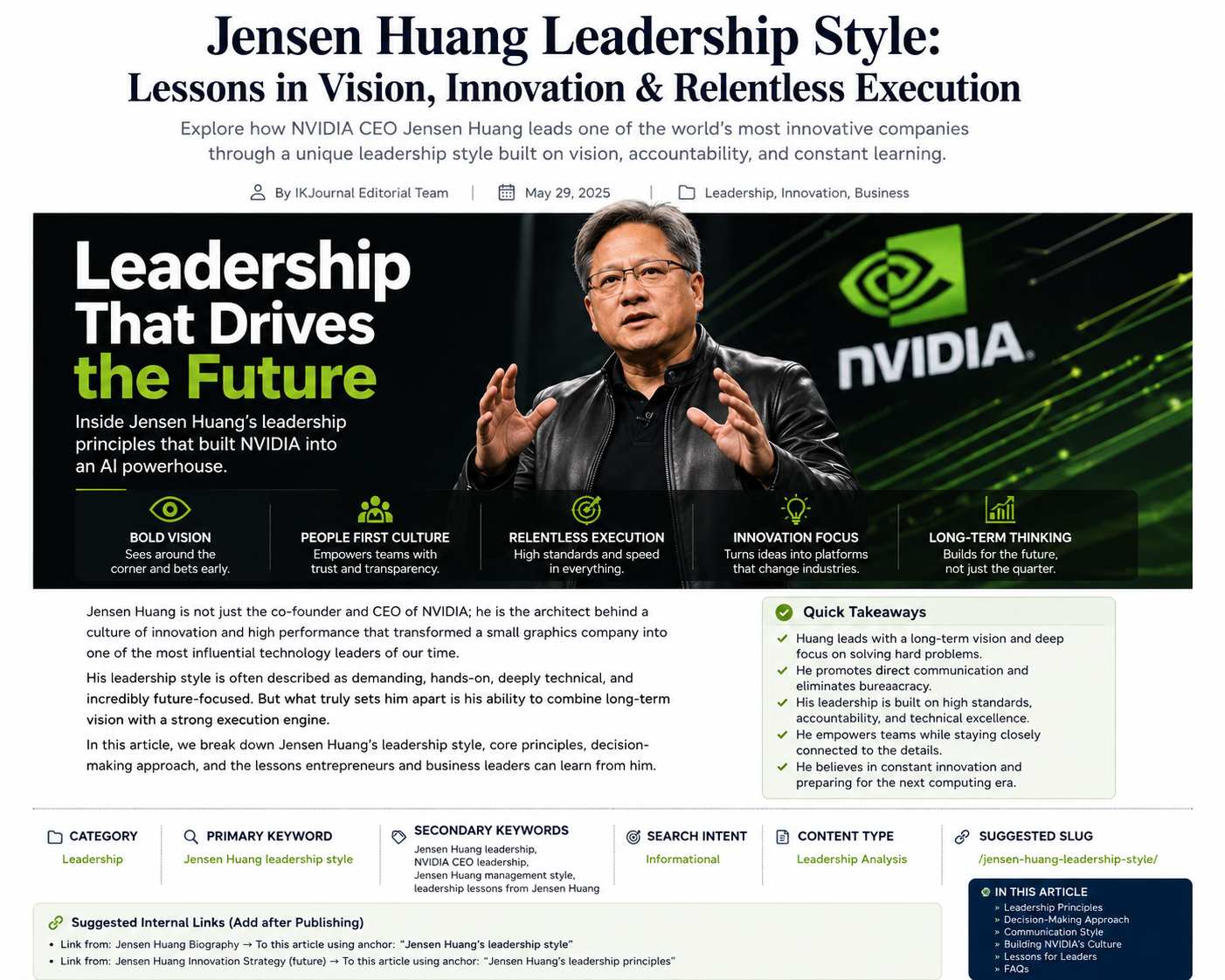
Jensen Huang’s leadership style is unlike that of many traditional technology CEOs.
He is not known for maintaining a comfortable distance from engineering teams, delegating every technical question, or relying only on layers of management to understand what is happening inside his company. Instead, Huang has developed a leadership approach built around technical depth, direct communication, high standards, intellectual honesty, and long-term thinking.
That approach has helped him lead NVIDIA from its founding in 1993 through several major changes in computing.
The company began as a graphics-focused semiconductor business. Today, NVIDIA is deeply involved in accelerated computing, artificial intelligence, data centers, robotics, and other emerging technologies.
So what makes Jensen Huang’s leadership style different?
And more importantly, what can entrepreneurs, CEOs, managers, and aspiring leaders actually learn from it?
This article examines the key principles behind Jensen Huang’s leadership style and the lessons that can be applied beyond NVIDIA.
Who Is Jensen Huang?
Jensen Huang is the co-founder, president, and CEO of NVIDIA.
He founded the company in 1993 with Chris Malachowsky and Curtis Priem and has remained its president and CEO since its beginning. NVIDIA’s official biography says Huang previously worked at LSI Logic and Advanced Micro Devices and holds engineering degrees from Oregon State University and Stanford University.
His engineering background is important when examining his leadership.
Huang has not approached NVIDIA simply as a business executive managing financial targets. His public career has consistently shown a strong interest in technology, computing architecture, artificial intelligence, and the future applications of NVIDIA’s products.
That technical foundation is one of the pillars of his management philosophy.
Related reading: Jensen Huang Biography: Career, NVIDIA, and the Journey of a Visionary Tech Leader
What Is Jensen Huang’s Leadership Style?
Jensen Huang’s leadership style can best be described as a combination of:
- Visionary thinking
- Technical involvement
- High standards
- Direct communication
- Intellectual honesty
- Long-term decision-making
- Relentless execution
- Continuous learning
- Strong accountability
His approach is demanding.
Recent reporting has highlighted Huang’s willingness to criticize work and his belief that continuous criticism can help people improve. In a 2026 interview reported by Fortune, Huang discussed the demanding management culture at NVIDIA and connected some of his approach to the high expectations he experienced from his parents.
However, describing him simply as a “tough boss” misses the bigger picture.
The more interesting question is why he maintains such high expectations.
His answer, as reflected in his public comments and reported management practices, is closely connected to the belief that extraordinary results require extraordinary effort.
1. Jensen Huang Leads With a Long-Term Vision
One of Huang’s most important leadership characteristics is his ability to think beyond the current product cycle.
NVIDIA did not remain a company focused only on traditional graphics.
Its GPUs became increasingly important for high-performance computing, data centers, machine learning, and artificial intelligence.
That transformation required years of technological investment.
A leader focused only on immediate revenue might ask:
“What is selling today?”
A long-term technology leader also asks:
“What will computing look like several years from now?”
That difference can completely change how a company allocates resources.
For entrepreneurs, this is one of the strongest lessons from Huang’s career.
You should understand today’s customers, but you should also watch the technological forces that could create tomorrow’s market.
2. Technical Knowledge Is Part of His Leadership Advantage
Huang is an engineer by training.
That matters because NVIDIA operates in a highly technical industry.
A CEO does not need to write every line of code or design every chip personally. But a deep understanding of technology can help a leader ask better questions.
It can also make it harder for complicated technical language to hide fundamental problems.
NVIDIA’s official biography confirms Huang’s electrical engineering education at Oregon State University and Stanford University.
His technical background therefore forms part of the foundation for his hands-on approach.
Why Technical Depth Matters
Consider two possible leadership conversations.
One CEO asks:
“Are we on schedule?”
Another asks:
“What technical assumption could make this schedule wrong?”
The second question can reveal much more.
Huang’s reputation for detailed questioning reflects this broader approach.
A leader does not necessarily need to know everything.
But knowing enough to challenge assumptions can make decision-making considerably stronger.
3. Intellectual Honesty Is Central to Huang’s Approach
One of the most frequently discussed elements of NVIDIA’s culture is intellectual honesty.
The concept is simple:
If something is wrong, say that it is wrong.
If you do not know something, admit that you do not know.
If an idea is failing, do not protect it simply because you originally supported it.
Recent reporting about NVIDIA’s culture has described Huang’s intolerance for excuses and his emphasis on people confronting problems directly rather than hiding behind external explanations.
This principle is especially valuable in innovative industries.
Innovation naturally involves uncertainty.
If employees are afraid to admit mistakes, management receives distorted information.
And when leaders make decisions based on distorted information, small problems can become large ones.
Failure Is Information
A failed experiment can still be useful.
A failed product can reveal what customers do not want.
A wrong assumption can reveal what a team needs to investigate.
The real danger is not necessarily failure.
The greater danger is learning too late that everyone knew something was wrong but nobody wanted to say it.
That is why intellectual honesty can become a competitive advantage.
4. He Pushes People Instead of Lowering the Standard
Huang has become known for demanding high performance.
Reports from current and former NVIDIA employees have described him as a demanding perfectionist who expects employees to be well prepared and intellectually honest.
Huang himself has also defended the idea that extraordinary accomplishments should not necessarily be easy.
This philosophy produces an important distinction.
A weak leader may lower the standard because achieving it seems difficult.
A strong leader may instead ask:
“What would we have to change to reach the standard?”
The second approach can encourage growth.
However, it also has a potential downside.
A demanding culture is not automatically a healthy culture.
High standards need to be combined with clear expectations, appropriate support, respect, and sustainable working practices.
That is an important qualification when studying Huang’s approach.
5. Direct Communication Reduces Information Silos
Another interesting element of Huang’s management system is his emphasis on information flow.
One reported NVIDIA practice involves employees sharing their “Top 5 Things”—important observations, developments, or issues—with leadership. Reports have described Huang using this kind of information to understand what is happening across the organization rather than relying exclusively on traditional hierarchical reporting.
Why is that useful?
Because large companies can easily develop information silos.
A problem may exist in one department while another department has already discovered the solution.
If information moves slowly, the organization becomes slower than the market.
If useful information moves quickly, leaders can react faster.
The Leadership Lesson
A CEO does not need to personally solve every problem.
But the CEO should build a system in which important information reaches the right people quickly.
That is a much more scalable form of leadership.
6. Huang Uses Criticism as a Development Tool
Huang’s willingness to criticize work is one of the more controversial aspects of his leadership style.
In 2026, he spoke publicly about the importance of criticism and described a culture in which work is continuously challenged. Fortune reported his comments about criticism and the high expectations placed on NVIDIA employees.
The useful principle here is not simply:
“Be critical.”
It is:
“Separate criticism of the work from rejection of the person.”
A good leader should be able to say:
- This idea has a weakness.
- This assumption needs evidence.
- This presentation is unclear.
- This product needs improvement.
without turning every disagreement into a personal attack.
When criticism is focused on improving the work, it can accelerate learning.
7. He Focuses on the Next Computing Platform
Huang’s leadership is also strongly connected to technological transitions.
NVIDIA’s 2026 CES presentation emphasized AI infrastructure, accelerated computing, robotics, autonomous systems, open models, and the company’s Vera Rubin platform.
This illustrates another characteristic of Huang’s leadership:
He tends to think in platforms rather than isolated products.
A product has a lifecycle.
A platform can support an ecosystem.
That distinction is strategically important.
Instead of asking only:
“How do we sell more of this product?”
a platform-oriented leader can ask:
“How can this technology become fundamental infrastructure for an entire industry?”
That is a much larger strategic question.
8. He Thinks in Ecosystems
NVIDIA’s business is not based only on chips.
Its influence also comes from software, developer tools, partnerships, cloud providers, research institutions, AI companies, robotics companies, and other parts of the technology ecosystem.
This ecosystem perspective has become increasingly important as AI infrastructure expands.
For leaders, the lesson is clear:
Your company’s competitive advantage may not exist entirely inside your own organization.
It may depend on the network surrounding your product.
That means leaders should understand:
- partners
- developers
- suppliers
- customers
- researchers
- competitors
- regulators
- complementary technologies
A strong ecosystem can make a product far more valuable.
9. Long-Term Thinking Over Short-Term Comfort
Huang’s career also demonstrates the value of making difficult investments before their payoff becomes obvious.
The transition from graphics processors to accelerated computing and AI required long-term technological development.
The benefit of such decisions may not appear immediately.
That creates a leadership challenge.
Short-term decisions are often easier to explain.
Long-term investments can look expensive, uncertain, or unnecessary.
A leader therefore needs the confidence to continue investing when the evidence supports a future opportunity—even when the market has not fully recognized it yet.
This does not mean blindly betting on every future trend.
It means distinguishing between:
speculation
and
a strategically supported long-term thesis.
That distinction is critical.
10. He Stays Close to Important Decisions
Huang’s management style is often described as hands-on.
That does not necessarily mean he personally manages every employee.
Instead, it means he remains deeply involved in important technical, strategic, and product-level questions.
For a technology company, this can be powerful.
The CEO can connect:
Technology → Product → Customer → Market → Strategy
instead of treating each area as a separate department.
This can improve strategic consistency.
But there is another lesson here.
Hands-on leadership works best when the organization still develops strong people who can make decisions independently.
Otherwise, the CEO becomes a bottleneck.
The goal should therefore be high involvement in critical decisions without creating organizational dependence on one person.
11. He Treats Innovation as a Continuous Process
Innovation is not a single event.
It is a process of:
Experiment → Learn → Improve → Scale → Repeat
Huang’s career at NVIDIA illustrates this idea.
The company did not simply discover AI and suddenly become an AI company.
Its current position developed through years of work in graphics, GPUs, parallel computing, software, developer ecosystems, data centers, and accelerated computing.
That history matters.
It demonstrates that today’s breakthrough may depend on capabilities built long before the breakthrough becomes obvious.
For entrepreneurs, this is a powerful reminder:
Do not judge every investment only by its immediate return.
Some capabilities become valuable later.
12. Jensen Huang’s Leadership Is Built Around Execution
Vision without execution is simply an idea.
This is another important part of Huang’s leadership style.
A company can identify the next big technological opportunity and still fail if it cannot execute.
Execution requires:
- talented teams
- clear priorities
- fast feedback
- strong engineering
- disciplined product development
- customer understanding
- infrastructure
- capital
- partnerships
NVIDIA’s rise therefore cannot be explained by vision alone.
The company also had to build the technology and ecosystem necessary to turn that vision into reality.
That is why execution deserves to sit alongside vision and innovation when discussing Huang’s leadership.
Jensen Huang Leadership Style: Key Principles
| Leadership Principle | What It Means |
|---|---|
| Long-term vision | Prepare for major technological shifts |
| Technical depth | Understand the technology behind the business |
| Intellectual honesty | Admit problems and uncertainty quickly |
| High standards | Push teams toward exceptional performance |
| Direct communication | Reduce information silos |
| Continuous criticism | Use feedback to improve ideas and execution |
| Ecosystem thinking | Build around partners and platforms |
| Innovation | Invest in capabilities before markets fully mature |
| Execution | Turn strategy into measurable results |
| Adaptability | Change direction when technology changes |
7 Leadership Lessons Entrepreneurs Can Learn From Jensen Huang
1. Do Not Confuse Difficulty With Impossibility
A difficult goal may require a different strategy rather than a smaller goal.
2. Learn Enough to Challenge Assumptions
You do not need to be the best engineer in the company.
But you should understand your business well enough to recognize weak assumptions.
3. Build a Culture Where Bad News Can Travel Fast
Leaders need accurate information more than comfortable information.
4. Think Beyond Your Current Product
Ask what your technology could enable next.
Your current product may be only the beginning of the opportunity.
5. Invest Before Everyone Else Agrees
Some of the strongest opportunities appear before they become obvious.
But long-term bets should still be based on evidence and strategic reasoning.
6. Demand Improvement Without Destroying Trust
High standards can produce exceptional results, but people also need clarity, respect, and support.
7. Turn Vision Into Systems
A vision becomes valuable only when an organization has the people, processes, technology, and resources to execute it.
Is Jensen Huang a Good Leader?
There is no objective one-word answer.
Huang’s results as NVIDIA’s long-term leader are extraordinary, and his leadership has been closely associated with the company’s transformation into a major force in accelerated computing and AI. NVIDIA’s official materials describe his role in guiding the company since its founding.
At the same time, a demanding management style is not automatically appropriate for every organization or every employee.
The better conclusion is that Huang demonstrates a particular leadership model:
high expectations + technical depth + direct information + long-term vision + relentless execution.
Some organizations may benefit from those principles.
Others may need a different balance.
Jensen Huang Leadership Style vs. Traditional CEO Leadership
| Area | Jensen Huang’s Reported Approach | Traditional Hierarchical Approach |
|---|---|---|
| Technical involvement | High | Often delegated |
| Communication | Direct and broad | Often layered |
| Feedback | Frequent and challenging | Often periodic |
| Decision-making | Strong CEO involvement | More hierarchical |
| Innovation | Long-term platform thinking | Often product/cycle focused |
| Standards | Extremely high | Varies |
| Information | Broad internal flow | Often filtered through management |
The comparison does not mean every traditional management system is ineffective.
Different organizations require different structures.
The important point is that Huang has built a management approach designed around a rapidly changing technical environment.
What Makes Jensen Huang’s Leadership Different?
The most distinctive aspect of Huang’s leadership may be the combination of several qualities that do not always appear together.
He combines:
engineering knowledge + business strategy + long-term vision + direct communication + demanding execution.
A leader can have vision without technical depth.
Another can have technical expertise without strategic thinking.
Another can be excellent at execution without understanding where the industry is going.
Huang’s leadership model attempts to connect all three.
That combination is particularly powerful in a technology company operating through major shifts in computing.
Final Thoughts
Jensen Huang’s leadership style offers more than a collection of motivational lessons.
It provides a practical example of how leadership can influence an entire company’s strategic direction.
His approach emphasizes technical understanding, high standards, intellectual honesty, direct information, long-term thinking, innovation, and execution.
Not every entrepreneur should copy his demanding style.
But almost every leader can learn something from the principles behind it.
The biggest lesson may be this:
A leader’s job is not simply to manage today’s business. It is to build an organization capable of succeeding in tomorrow’s environment.
That requires knowing when to protect the current business, when to challenge existing assumptions, and when to invest in a future that other people may not yet fully see.
That combination of vision and execution is one of the defining characteristics of Jensen Huang’s leadership at NVIDIA.
Frequently Asked Questions
What is Jensen Huang’s leadership style?
Jensen Huang’s leadership style combines technical depth, high standards, direct communication, intellectual honesty, long-term thinking, and a strong focus on execution.
Why is Jensen Huang considered a successful leader?
He has led NVIDIA since its founding in 1993 and guided the company through major changes in graphics, accelerated computing, data centers, and artificial intelligence.
Does Jensen Huang believe in criticism?
Yes. Huang has publicly discussed criticism as part of NVIDIA’s demanding culture and has emphasized continuous improvement rather than avoiding difficult feedback.
What can entrepreneurs learn from Jensen Huang?
Entrepreneurs can learn the value of long-term thinking, technical understanding, honest feedback, ecosystem building, adaptability, and disciplined execution.
What is intellectual honesty in leadership?
Intellectual honesty means being willing to admit when an idea is wrong, when information is uncertain, or when a strategy is not working instead of protecting an assumption simply because it was previously accepted.
Does Jensen Huang focus on innovation?
Yes. Innovation and technological transition have been central to NVIDIA’s development, particularly as GPUs expanded from graphics into accelerated computing and AI.
Conclusion
Jensen Huang’s leadership style is not built around one secret formula.
It is the combination of several demanding principles.
Understand the technology.
Think beyond the current market.
Tell the truth about problems.
Challenge assumptions.
Accept difficult feedback.
Invest for the long term.
And most importantly, turn vision into execution.
That combination has helped Huang lead NVIDIA through one of the most significant periods of change in modern computing.
For entrepreneurs and business leaders, his story provides a valuable reminder: great leadership is not only about seeing the future. It is about building the organization capable of reaching it.