 By IK Journal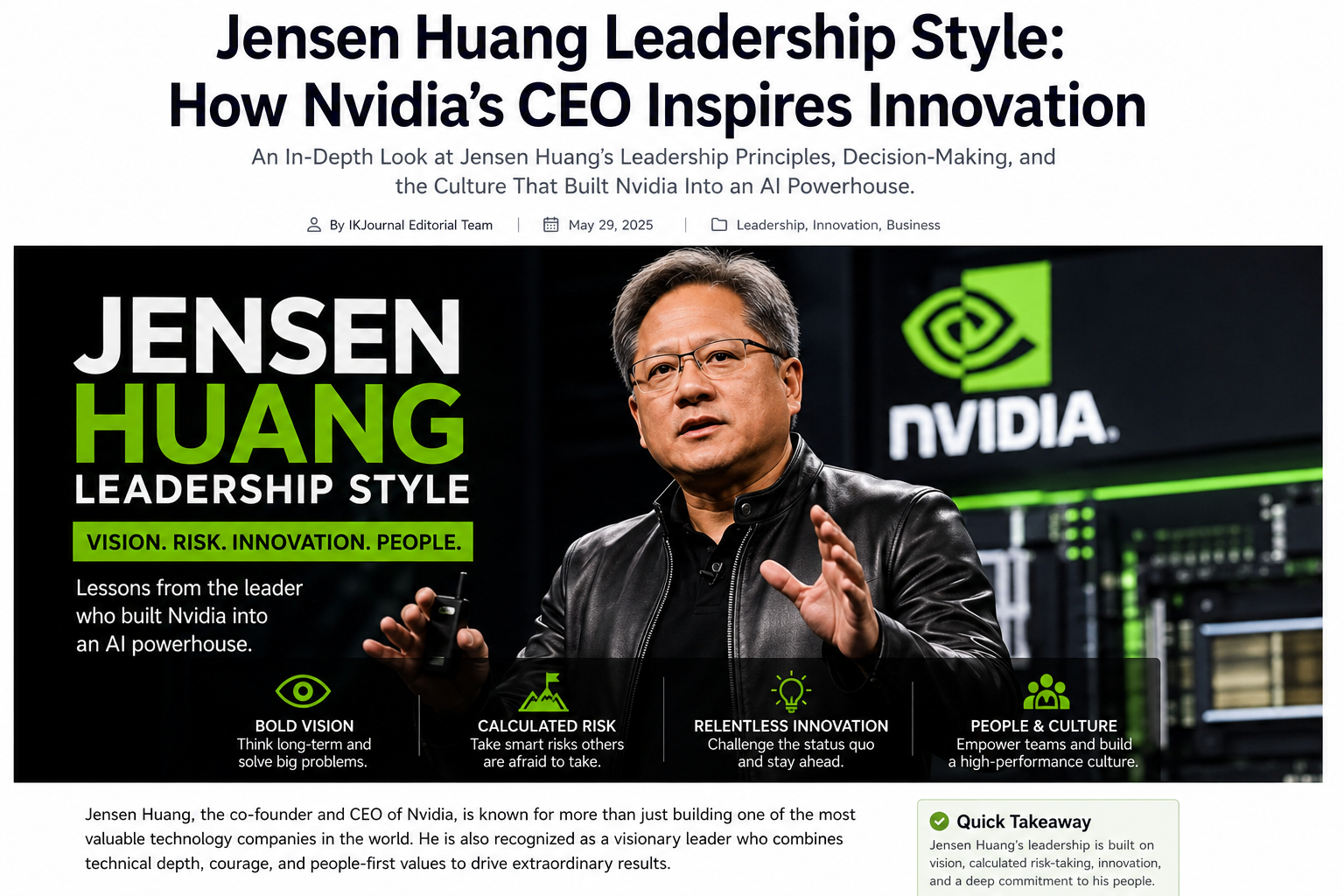
Jensen Huang is one of the most recognizable leaders in modern technology. As the co-founder, president, and CEO of NVIDIA, he has spent more than three decades guiding the company through major shifts in computing—from PC graphics and gaming to accelerated computing and artificial intelligence.
What makes Huang’s story particularly interesting is not simply NVIDIA’s enormous growth. It is the sequence of decisions behind that growth. NVIDIA began in 1993 as a graphics-chip company and later became one of the central companies powering the modern AI infrastructure boom.
So, who is Jensen Huang, how did he build NVIDIA, and what can his career teach entrepreneurs and business leaders?
This Jensen Huang biography explores his early life, education, career, NVIDIA journey, leadership philosophy, and role in the transformation of modern computing.
Jensen Huang Quick Facts
| Fact | Details |
|---|---|
| Full name | Jensen Huang |
| Born | February 17, 1963 |
| Birthplace | Tainan, Taiwan |
| Profession | Engineer, entrepreneur, technology executive |
| Best known for | Co-founding and leading NVIDIA |
| NVIDIA founded | 1993 |
| Current role | Founder, President and CEO of NVIDIA |
| Undergraduate degree | Electrical engineering, Oregon State University |
| Graduate degree | Electrical engineering, Stanford University |
| Previous employers | LSI Logic and Advanced Micro Devices |
| Main areas of influence | GPUs, accelerated computing, AI infrastructure |
NVIDIA’s official biography confirms that Huang has served as the company’s president and CEO since its founding and that he previously worked at LSI Logic and Advanced Micro Devices. It also confirms his engineering education at Oregon State University and Stanford University.
Who Is Jensen Huang?
Jensen Huang is a Taiwanese-born American entrepreneur and engineer best known as the co-founder and longtime leader of NVIDIA.
His career is unusual because he did not simply create a company and then hand it over to professional management. Huang has remained closely involved with NVIDIA throughout its evolution.
According to NVIDIA, he founded the company in 1993 and has served as president and chief executive officer from the beginning.
Under his leadership, NVIDIA moved from a relatively specialized graphics-chip business toward a much broader computing platform company.
That transition is one of the most important parts of Huang’s career.
Jensen Huang’s Early Life
Huang was born in Tainan, Taiwan, in 1963.
As a child, his family later moved to Thailand, and eventually Huang and his brother were sent to the United States. Forbes notes that Huang was born in Taiwan, moved to Thailand as a child, and later went to the United States as the family responded to political and social instability in the region.
His early experiences across different countries became part of a much larger personal journey.
Instead of following a traditional business-school route, Huang developed his career around engineering and technology.
That technical foundation would later become one of the defining characteristics of his leadership.
Jensen Huang’s Education
Huang studied electrical engineering at Oregon State University, where he earned his bachelor’s degree.
He later attended Stanford University and earned a master’s degree in electrical engineering.
NVIDIA confirms both degrees in its official executive biography.
His educational background matters because Huang has remained deeply connected to the technical side of NVIDIA’s business.
For him, technology is not simply something that a CEO receives through reports from engineering teams. Understanding the underlying technology has helped him participate directly in conversations about products, computing architecture, and long-term technological change.
Jensen Huang’s Early Career
Before founding NVIDIA, Huang worked in the semiconductor industry.
NVIDIA identifies LSI Logic and Advanced Micro Devices as two of the companies where Huang worked before becoming an entrepreneur.
These experiences gave him exposure to semiconductor engineering and the rapidly developing personal-computer industry.
That background became extremely valuable when Huang and his co-founders started NVIDIA.
He was not entering an industry he knew only from the outside. He already understood the technology and the competitive environment.
When Did Jensen Huang Found NVIDIA?
Jensen Huang co-founded NVIDIA in 1993.
The company initially focused on graphics technology, at a time when personal computers were becoming increasingly important for gaming and multimedia.
The original opportunity was much narrower than the market NVIDIA eventually entered.
NVIDIA’s own history describes the company’s development from PC graphics toward accelerated computing and AI. Its invention of the GPU in 1999 became a major turning point for computer graphics and later became an important foundation for parallel computing and modern AI.
The GPU Changed NVIDIA’s Future
One of the biggest reasons Jensen Huang’s career is important is the role of the GPU in NVIDIA’s evolution.
Graphics processors were originally associated primarily with visual computing and gaming.
But GPUs were also exceptionally useful for certain types of parallel computation.
That created a much bigger opportunity.
NVIDIA’s GPU technology eventually became important for data centers, scientific computing, machine learning, and artificial intelligence.
The company’s own history describes the GPU as a technology that first helped reshape computer graphics and later helped ignite modern deep learning.
This is a powerful lesson in business strategy:
A technology can have a much larger future use than its original market suggests.
Huang’s leadership repeatedly focused on that possibility.
Jensen Huang and NVIDIA’s AI Transformation
NVIDIA’s transformation into an AI infrastructure leader did not happen overnight.
It developed from years of investment in accelerated computing, developer ecosystems, software, hardware, and research.
As AI workloads expanded, GPUs became increasingly important because of their ability to perform large numbers of calculations in parallel.
Huang has increasingly described AI as a new computing platform rather than simply another software trend.
At NVIDIA’s 2026 CES presentation, the company introduced its Rubin platform and presented AI infrastructure as a major shift across computing, robotics, autonomous systems, and other industries.
In May 2026, Huang also told Carnegie Mellon graduates that they were beginning their careers during what he described as the start of a new AI era.
These statements illustrate a central part of his leadership philosophy: recognize major technological transitions early and prepare for them before they become obvious to everyone.
What Is Jensen Huang’s Leadership Style?
Jensen Huang’s leadership style is often described as demanding, technically involved, direct, and highly focused on continuous improvement.
Reports about NVIDIA’s internal culture have highlighted Huang’s preference for direct communication, high standards, and detailed engagement with the company’s work.
Business Insider reported that employees have described Huang as demanding and perfectionistic, while also noting his emphasis on intellectual honesty and willingness to engage deeply with operational details.
That approach is not necessarily comfortable for every employee.
But Huang’s philosophy is based on the belief that extraordinary goals require extraordinary effort.
He has also been associated with a relatively flat management structure and unusually direct access to information from employees.
Why Direct Communication Matters to Huang
One of the interesting features of Huang’s management philosophy is his desire to reduce information filtering.
In a traditional hierarchy, information can pass through several management layers before reaching the CEO.
Every layer can potentially remove context, soften bad news, or unintentionally change the meaning of the original message.
Huang has tried to reduce that problem through direct communication.
The Wall Street Journal has reported on NVIDIA’s use of “Top-5 Things” emails, through which employees communicate important issues and observations directly upward.
The broader lesson is important:
Leaders make better decisions when they have access to reality rather than only polished summaries of reality.
A Leadership Culture Built Around Intellectual Honesty
Another notable part of Huang’s approach is his emphasis on intellectual honesty.
A high-performing organization cannot improve if people are afraid to admit that something is wrong.
If employees hide mistakes, leaders receive an unrealistic picture of the business.
If problems are discussed openly, teams can learn faster.
Reports on NVIDIA’s culture have highlighted Huang’s focus on admitting mistakes and examining problems rather than simply protecting appearances.
This is especially relevant for technology companies because innovation naturally involves failure.
A company that tries to eliminate every mistake may also eliminate experimentation.
Jensen Huang’s Approach to Innovation
Huang’s leadership is closely connected to NVIDIA’s culture of long-term technological investment.
One of his most important strategic characteristics is the willingness to invest in technologies before their eventual markets are completely obvious.
NVIDIA’s history provides a clear example.
The company began with graphics technology. The GPU later became useful for much broader forms of accelerated computing, and eventually became central to AI workloads.
The lesson is not that every entrepreneur should invest in speculative technology.
The lesson is that leaders should understand the underlying capability of their technology and continually ask:
“What else could this technology make possible?”
That question can reveal markets that are invisible when a company focuses only on its current customers.
Jensen Huang’s Five Leadership Lessons
1. Think Beyond the Current Market
A company’s first market does not necessarily define its final opportunity.
NVIDIA’s journey from graphics to accelerated computing and AI is a strong example.
Entrepreneurs should continually examine what their technology can do beyond its original application.
2. Stay Close to the Product
Huang’s engineering background has remained relevant throughout his career.
Technical understanding can help leaders ask better questions, evaluate trade-offs, and communicate more effectively with specialists.
Business leaders do not need to become experts in every technical field.
But understanding the fundamentals of their own product can be a significant advantage.
3. Make Information Move Faster
Large organizations can become slow when information must travel through too many layers.
Huang’s emphasis on direct communication demonstrates another model: make it easier for useful information to reach decision-makers.
The right system can help leaders identify problems earlier.
4. Treat Innovation as a Long-Term Process
Innovation is rarely one breakthrough.
It is usually a chain of investments, experiments, failures, improvements, and strategic decisions.
NVIDIA’s evolution illustrates how a company can build capabilities over many years before those capabilities become central to a new market.
5. Keep Challenging the Company
Success can create its own danger.
When a business becomes successful, employees may become comfortable with existing products and strategies.
Huang’s public leadership consistently emphasizes technological change and the need to prepare for the next computing platform.
That mindset helps explain why NVIDIA has repeatedly repositioned itself as technology has evolved.
Jensen Huang’s Recent Role in the AI Era
Huang remains NVIDIA’s founder, president, and CEO in 2026.
His role has expanded far beyond traditional semiconductor leadership.
NVIDIA is now involved in AI infrastructure, accelerated computing, robotics, autonomous systems, and other emerging technology areas.
In July 2026, Reuters reported that NVIDIA announced partnerships with Japanese robotics companies including FANUC and Yaskawa Electric to accelerate robotics and AI development. Huang described AI as a technology that could make robots smarter, more adaptable, and more accessible.
This shows how his vision continues to move beyond GPUs as individual products toward computing platforms that support entire ecosystems.
Jensen Huang’s Recognition
Huang has received major recognition throughout his career.
NVIDIA lists honors including the Robert N. Noyce Award from the Semiconductor Industry Association, the IEEE Founder’s Medal, the Dr. Morris Chang Exemplary Leadership Award, and election to the National Academy of Engineering.
NVIDIA also notes that he was appointed to the U.S. President’s Council of Advisors on Science and Technology in 2026.
These recognitions reflect both his technical contributions and his influence as a technology leader.
Jensen Huang’s Net Worth
Huang’s wealth has increased dramatically alongside NVIDIA’s rise, but net-worth figures should be treated as estimates rather than fixed facts.
Forbes’ real-time profile reported Huang’s estimated fortune at about $170 billion on July 27, 2026, while its profile notes that he owns approximately 3% of NVIDIA. Because much of his wealth is tied to NVIDIA shares, the estimate can change substantially as the stock price moves.
Earlier in May 2026, Forbes reported that Huang’s fortune briefly exceeded $200 billion as NVIDIA shares rose.
These numbers demonstrate why a celebrity or business leader’s net worth should never be presented as a permanent figure.
For Huang, changes in NVIDIA’s stock price can materially change the estimated value of his holdings.
What Makes Jensen Huang Different From a Typical CEO?
Huang’s story is unusual for several reasons.
First, he has led the same technology company since its founding.
Second, he has maintained a strong technical identity while running a huge global business.
Third, NVIDIA’s evolution has required repeated changes in strategic direction.
The company moved from gaming graphics toward professional visualization, high-performance computing, data centers, accelerated computing, and AI.
That makes Huang’s career less about managing a single successful product and more about repeatedly positioning the company for the next computing transition.
What Entrepreneurs Can Learn From Jensen Huang
Jensen Huang’s career offers several practical lessons for entrepreneurs.
Understand your technology deeply.
A leader who understands the underlying product can often see opportunities that others miss.
Build for the future, not only the present.
NVIDIA’s biggest opportunities developed from capabilities that had been built years earlier.
Do not hide difficult information.
Bad news received early is often more valuable than good news received too late.
Keep improving after success.
Market leadership can disappear quickly when competitors or technologies change.
Think in platforms.
The largest opportunities may come when a product becomes part of a much larger ecosystem.
These lessons do not mean every business should copy NVIDIA’s management structure. Different companies require different cultures.
The more useful takeaway is to understand the principles behind Huang’s decisions and determine which ones fit a particular organization.
Frequently Asked Questions
Who is Jensen Huang?
Jensen Huang is the co-founder, president, and CEO of NVIDIA. He founded the company in 1993 and has led it since its beginning.
What is Jensen Huang known for?
He is best known for co-founding NVIDIA and helping guide the company from graphics processors into accelerated computing and AI infrastructure.
When did Jensen Huang found NVIDIA?
Jensen Huang co-founded NVIDIA in 1993.
What did Jensen Huang study?
Huang earned a bachelor’s degree in electrical engineering from Oregon State University and a master’s degree in electrical engineering from Stanford University.
What is Jensen Huang’s leadership style?
His leadership style is widely characterized by high standards, direct communication, technical involvement, intellectual honesty, and a strong focus on long-term innovation.
What is Jensen Huang’s estimated net worth?
His estimated net worth changes with NVIDIA’s stock price. Forbes reported approximately $170 billion on July 27, 2026, while an earlier May 2026 surge temporarily pushed the estimate above $200 billion.
Final Thoughts
Jensen Huang’s biography is ultimately a story about technological transitions.
He helped build NVIDIA at a time when graphics processors were primarily associated with computer graphics and gaming. Over the following decades, the company’s technology became increasingly important to accelerated computing and artificial intelligence.
His leadership style is equally significant.
Huang combines technical knowledge, direct communication, demanding standards, long-term thinking, and a willingness to rethink the company’s direction when technology changes.
For entrepreneurs and business leaders, perhaps the most valuable lesson is not to copy Jensen Huang’s exact management style.
It is to develop the ability to recognize where technology is heading, build capabilities before they become obvious, and remain willing to reinvent the business when the next major opportunity appears.
That mindset has been central to Jensen Huang’s journey—and it may be one of the most important reasons NVIDIA has remained at the center of the modern computing revolution.